
Keyword Density: How to Check for Keyword Stuffing
There is no perfect keyword density. Learn what Google says about keyword stuffing, how to read a density report, and how to fix repetitive copy before you publish.
Keyword density is the share of words on a page taken up by one word or phrase. If a 1,000-word article uses "rank tracker" 20 times, that phrase makes up about 2% of the text. For years people chased a perfect number: 1%, 2.5%, 3%. That number never existed, and Google says plainly that it does not want you to chase it.
Density is still worth checking, but for a different reason. It is a quick way to find copy that repeats itself so often that readers notice, which is exactly what Google describes as keyword stuffing. This guide explains what Google actually says, how to read a density report without overreacting to it, and a short review you can run on any page before you publish.
Quick answer
There is no ideal keyword density. Write for the reader, use the main phrase where it naturally belongs (title, opening, a heading or two, and the body), and use related words and variations everywhere else. Run a density check only to catch accidental repetition: if one phrase keeps showing up in sentences that would read better without it, rewrite those sentences. Do not add keywords to reach a target percentage.
What Google says about keyword density and stuffing
Two official Google Search Central pages cover this topic directly.
- Spam policies. Google defines keyword stuffing as "filling a web page with keywords or numbers in an attempt to manipulate rankings." Its examples include lists of phone numbers without added value, blocks of text listing cities and regions a page wants to rank for, and repeating the same words or phrases "so often that it sounds unnatural." Pages that break spam policies can rank lower or be left out of results.
- SEO Starter Guide. In its list of things not to focus on, Google says excessively repeating the same words, "even in variations," is tiring for users and that keyword stuffing is against its spam policies. The same section says content length alone does not matter for ranking and that there is no magical word count target.
The Starter Guide also makes a useful point in the opposite direction: when you vary your wording naturally, you have more chances to appear in search simply because you are using more of the words people search with. One searcher types "check keyword stuffing", another "keyword density checker", a third "is my article too repetitive". One natural page can match all three without repeating any of them ten times.
Why the old percentage rules do not help
A fixed percentage ignores almost everything that decides whether a page is useful:
- Page length changes the maths. Five mentions in a 300-word product description and five mentions in a 3,000-word guide produce very different percentages, yet both can read naturally.
- Some topics force repetition. A guide about WordPress backups will say "WordPress" many times because a product name has no good synonym. That is not stuffing.
- Placement matters more than count. One clear use in the title and opening line tells readers they are in the right place. Ten extra mentions in the footer tell them nothing.
- Search engines understand related language. Writing about rank tracking while also using "position history", "SERP movement" and "keyword positions" covers the topic better than repeating one phrase.
So treat any percentage as a smoke alarm, not a thermostat. It tells you to take a look. It does not tell you what to set the page to.
How to read a keyword density report
A density checker counts words and phrases and divides each count by the total. The SeoToolls Keyword Density Checker works this way, and knowing exactly what it counts makes the report much easier to interpret:
- It shows single words, two-word phrases and three-word phrases. The longer phrases are usually more revealing, because stuffing tends to repeat a whole phrase such as "best rank tracker tool".
- It only lists terms that appear more than once, sorted by how often they appear.
- It ignores words of one or two letters, but common words such as "the", "and" and "for" are still counted. Expect them near the top of the single-word list and skip past them.
- Its colour labels are rough prompts. Terms above 3% are marked High and above 5% Too High. Use those labels as a reason to reread the sentences, not as rules. A product name on a short page can pass 5% legitimately, and a stuffed phrase on a long page can stay under 2%.
- Text mode and URL mode measure different things. Paste your article into the text box to analyse the body copy. The URL option analyses only the page's title, meta description and meta keywords tag, so it is useful for checking whether your metadata repeats itself, not for judging the article body.
A 15-minute keyword stuffing check before you publish
Run this on new articles, service pages and product descriptions. It works best when someone other than the writer does it.
- Write down the main phrase and two or three close variations. For this article that would be "keyword density", "keyword stuffing" and "density checker".
- Paste only the body text into the checker. Leave out navigation and footer text so the numbers reflect what the reader actually reads.
- Start with the three-word list. If a long phrase you did not plan to repeat appears four or five times, find each instance. Repeated long phrases are the clearest sign of copy written for a search engine rather than a person.
- Check where the main phrase appears. It belongs in the title, the opening paragraph and wherever it is the most natural way to say something. It does not need to be in every heading.
- Read the flagged paragraphs aloud. If a sentence sounds odd spoken, rewrite it with a pronoun or a variation, or remove the phrase altogether.
- Look for lists that only exist to hold keywords. Rows of city names, product codes or "related searches" with no explanation match the examples Google gives for stuffing.
- Check the metadata separately. Use the URL option or the Meta Tags Analyzer to make sure the title and description do not repeat the same phrase twice.
- Run the check again after editing and confirm that the phrase you trimmed no longer stands out while the page still clearly covers its topic.
Signs a page is repetitive, even with a "good" percentage
Density can look normal while the page still reads badly. Watch for these patterns:
- Every heading starts with the same phrase.
- The opening paragraph uses the main phrase more than twice.
- Image alt text repeats the keyword instead of describing the image.
- Internal links all use identical anchor text.
- A block near the bottom lists variations of the keyword with no sentences around them.
- The FAQ asks the same question three ways to fit in more variations.
Each of these is easy to fix. Vary the headings, describe images for people who cannot see them, and write anchor text that tells the reader what they will find on the next page. Our on-page SEO checklist covers headings, titles and alt text in more detail.
A worked example
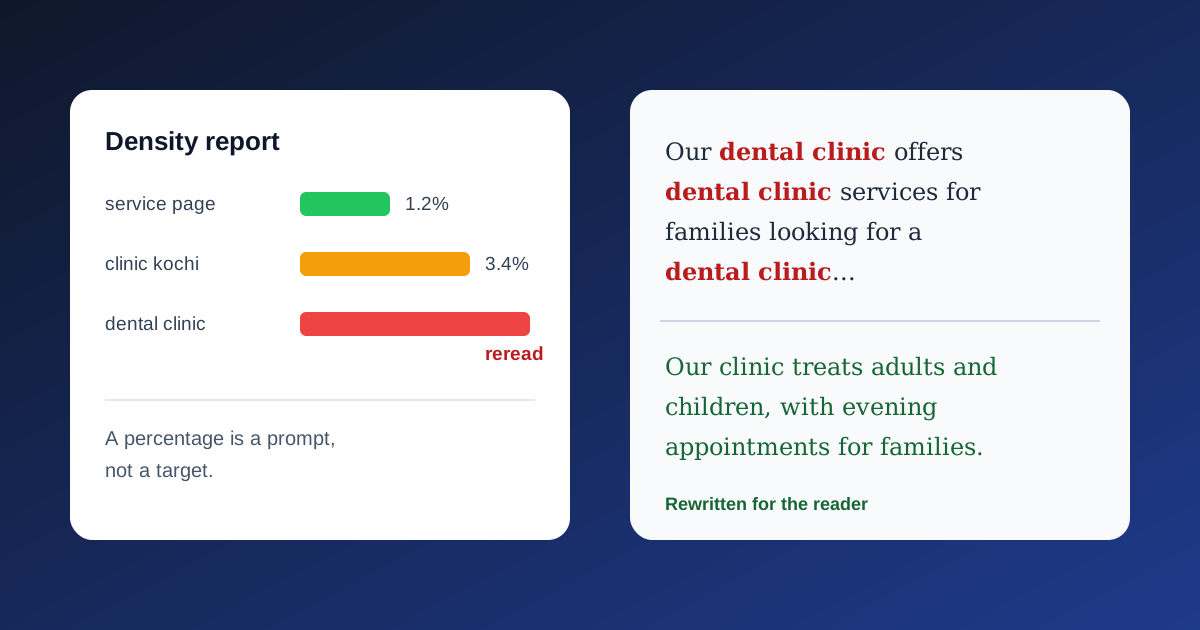
Imagine a 900-word service page for a dental clinic. The density report shows "dental clinic kochi" 14 times among the three-word phrases, under 2% of them, which no colour label would flag. Reading the page tells a different story: most mentions sit in sentences like "Our dental clinic in Kochi offers dental clinic in Kochi services for families looking for a dental clinic in Kochi."
The fix is not to cut the count to an arbitrary number. It is to rewrite for the patient: "Our clinic in Kochi treats adults and children, with evening appointments for working families." Keep the full phrase in the title, the opening line and the contact section where it genuinely helps. After the rewrite the phrase appears four times, and the page now also mentions treatments, opening hours and the neighbourhood, which are the details patients actually search for.
The lesson is the one Google's examples point to: the problem was never the percentage. It was a sentence no person would write.
Where density fits in a wider content review
A density check takes a few minutes and catches one specific problem. It does not tell you whether the page answers the searcher's question, whether it is up to date, or whether a stronger page on your site already targets the same query. Combine it with:
- a keyword research pass to confirm the intent behind the main phrase before you write;
- the Readability Checker to spot long, tangled sentences, which often appear when phrases are forced in;
- a periodic content audit to find older pages written to old density rules that now need a rewrite.
FAQ
What is a good keyword density percentage?
Google does not recommend any percentage. Use the main phrase where it is natural and vary your wording elsewhere. A density report is only useful for spotting accidental repetition.
Can keyword stuffing hurt rankings?
Yes. Keyword stuffing is listed in Google's spam policies, and Google says sites that violate those policies may rank lower or not appear in results at all, through automated systems or manual actions.
Should I remove the keyword from my headings?
No. Use it in a heading where it describes the section well. Just avoid starting every heading with the same phrase.
Does Google use the meta keywords tag?
No. Google's SEO Starter Guide says Google Search does not use the keywords meta tag, so there is no benefit in filling it with variations.
Is a longer article better for ranking?
Not by itself. Google says length alone does not matter for ranking. Write as much as the topic needs and stop there.
Sources
- Google Search Central, Spam policies for Google web search (keyword stuffing section), checked 12 October 2026.
- Google Search Central, SEO Starter Guide ("Things we believe you shouldn't focus on"), checked 12 October 2026.
Related SEO guides
AI Overview Visibility Audit for Small Sites
Audit how a small site shows up around AI Overviews: crawl access, concise answers, source-worthy sections, Search Console signals, and content rewrite priorities.
Low-Performing Content: Fix Weak Pages in 30 Minutes
A focused workflow for finding weak pages, checking metadata, refreshing stale sections, improving internal links, and deciding what to fix first.
SEO Content Audit Checklist for Small Sites in 2026
A practical content audit workflow for small sites that need better rankings, stronger internal links, and clearer AI visibility signals.